
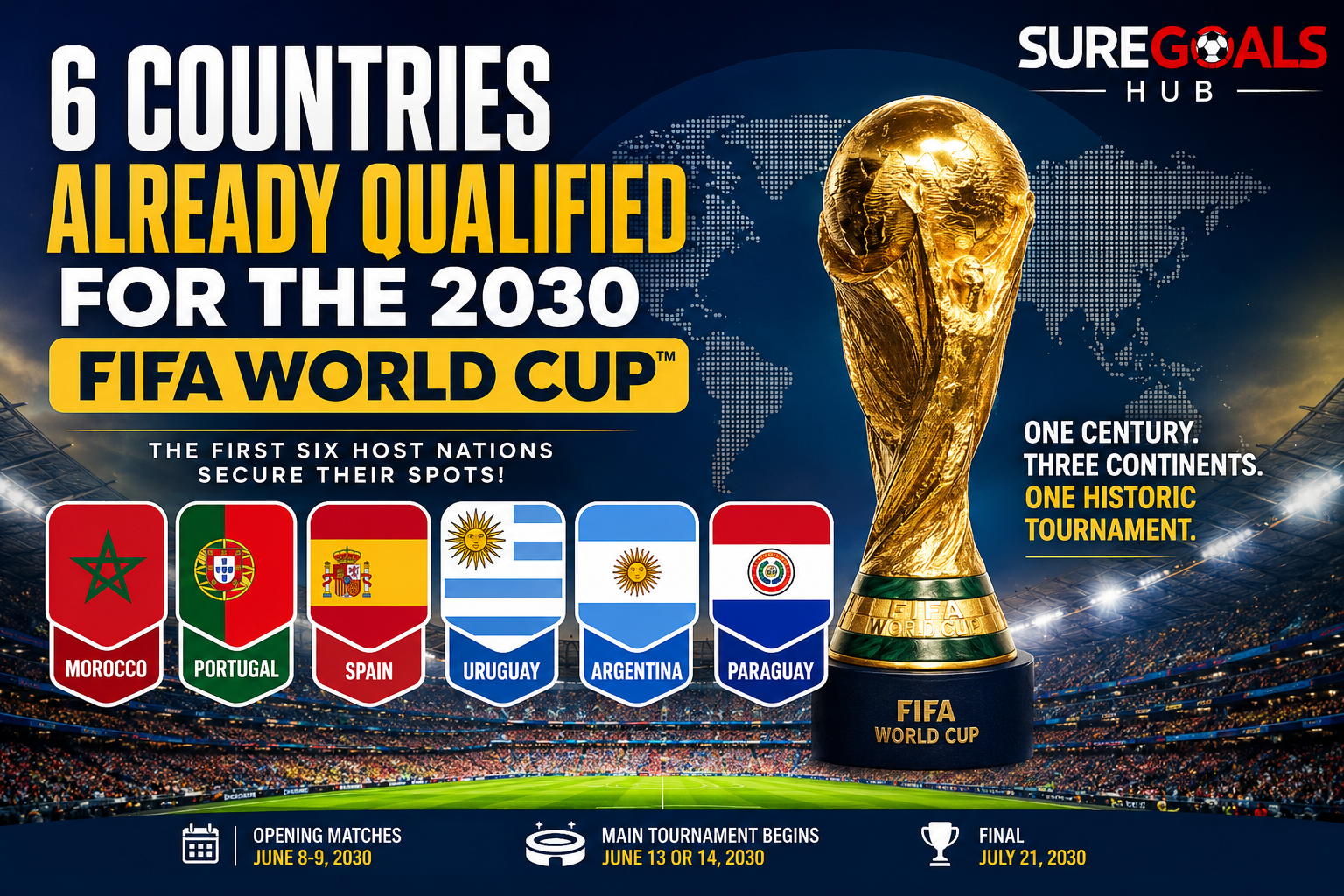
The road to the 2030 FIFA World Cup has officially begun, and while most nations are still dreaming of qualification, six countries already know they will be there.
In a historic first, FIFA has confirmed that the tournament will be hosted across three continents, creating one of the most unique World Cups ever staged. The decision not only celebrates football’s global reach but also marks the 100th anniversary of the very first FIFA World Cup, held in Uruguay in 1930.
With the hosts automatically securing their places in the tournament, fans can already look forward to seeing six nations in action when the world’s biggest football competition kicks off in 2030.
Which Countries Have Already Qualified for the 2030 FIFA World Cup?
The six nations guaranteed a place at the 2030 FIFA World Cup are the following:
- 🇲🇦 Morocco
- 🇵🇹 Portugal
- 🇪🇸 Spain
- 🇺🇾 Uruguay
- 🇦🇷 Argentina
- 🇵🇾 Paraguay
These countries earned automatic qualification after FIFA approved the unprecedented six-host format during an Extraordinary FIFA Congress in December 2024.
Unlike previous tournaments, qualification did not come through the traditional qualifying campaign. Instead, the hosting rights automatically secured their participation in the competition.
Why Is the 2030 World Cup Being Hosted by Six Countries?
The 2030 edition will be unlike any World Cup in football history.
To celebrate 100 years since the inaugural FIFA World Cup, FIFA created a special hosting arrangement that spans Europe, Africa, and South America.
Morocco, Portugal, and Spain will host the majority of the tournament, while Uruguay, Argentina, and Paraguay will stage special opening-week matches to honour football’s origins.
The idea is designed to connect the sport’s rich history with its modern global appeal, creating a celebration that stretches across continents.
Morocco, Portugal and Spain Will Host Most of the Tournament
Although six countries are officially listed as hosts, Morocco, Portugal, and Spain will carry the biggest responsibility.
The trio will organise 101 matches, including the following:
- The official tournament opening
- Most of the group-stage games
- Knockout rounds
- The 2030 FIFA World Cup Final
Fans can expect modern stadiums, world-class infrastructure, and one of the largest sporting events ever hosted across the three nations.
Why Uruguay, Argentina and Paraguay Are Part of the Tournament
South America’s role is symbolic but deeply meaningful.
Uruguay will host the official centenary celebration in Montevideo, the city where the first FIFA World Cup began in 1930.
The nation also lifted the very first World Cup trophy, making it the perfect place to celebrate the tournament’s 100th birthday.
Argentina was selected because it reached the inaugural World Cup final, while Paraguay was included as the headquarters of CONMEBOL, South America’s governing football body.
Each country will host one special opening-week fixture before the tournament shifts permanently to Europe and Africa.
FIFA Adjusts the Schedule for Historic Travel
With teams travelling between South America, Europe and Africa, FIFA has confirmed that the match calendar has been adjusted.
Additional travel and recovery days will be included to ensure the six teams involved in the centenary matches are not placed at a competitive disadvantage.
According to FIFA’s current schedule:
- Opening celebration matches are expected on June 8–9, 2030
- The main tournament begins around June 13 or 14, 2030
- The FIFA World Cup Final is scheduled for July 21, 2030
Despite the extra travel, FIFA says the revised calendar will remain within the existing international football schedule without requiring additional player release periods from clubs.
Saudi Arabia Confirmed as 2034 FIFA World Cup Hosts
During the same Extraordinary FIFA Congress, member associations also officially confirmed Saudi Arabia as the sole host nation for the 2034 FIFA World Cup.
The approval concluded FIFA’s bidding process for both the 2030 and 2034 tournaments.
What This Means for the Rest of the World
While six nations have already booked their tickets, the remaining places will be decided through qualification campaigns across FIFA’s continental confederations.
Powerhouses such as Brazil, England, France, Germany, Italy, Nigeria, the United States and many others must still earn their place on football’s biggest stage.
As qualification begins around the world, competition for the remaining spots is expected to be fierce.
Final Thoughts
The 2030 FIFA World Cup is already shaping up to be one of the most memorable tournaments ever staged. By combining six host nations across three continents, FIFA is celebrating a century of World Cup history while showcasing football’s truly global appeal.
For Morocco, Portugal, Spain, Uruguay, Argentina, and Paraguay, the journey is already guaranteed. For every other nation, the race to reach football’s grandest stage is only just beginning.
What countries have already qualified for the 2030 FIFA World Cup?
Morocco, Portugal, Spain, Uruguay, Argentina and Paraguay have automatically qualified as host nations.
Why are six countries hosting the 2030 FIFA World Cup?
FIFA chose six host nations to celebrate the 100th anniversary of the first FIFA World Cup, which was held in Uruguay in 1930.
Who will host most of the 2030 FIFA World Cup matches?
Morocco, Portugal and Spain will host the majority of the tournament, including the opening ceremony, knockout rounds and the final.
When will the 2030 FIFA World Cup begin?
The centenary celebration matches are expected on June 8–9, 2030, while the main tournament will begin around June 13 or 14, 2030.
Who will host the 2034 FIFA World Cup?
Saudi Arabia has been confirmed by FIFA as the host nation for the 2034 FIFA World Cup.

